College Dorms, Host Families, and With Parents-Where is ‘Home’?

For many college students, the concept of ‘home’ is fluid, and being sent home from university has proved stressful and confusing. At school, ‘going home’ can mean walking back to your room on campus, or getting on a plane to visit your parents. When studying abroad, I was excited to come ‘home’ to my host family’s apartment after spending a week moving from hostel to hostel in Italy. The place students consider their ‘home’ varies from person to person, and often has to do with where you feel the most stability and comfort.

Being sent home has felt surreal and frustrating for a number of reasons, but the main one being that I don’t really consider where I live with my family as ‘home’– BU’s Charles River Campus is. Of course, a big part of this is that I’ve spent most of my time away from Westerly since starting college. Another is the way my life away from campus has changed drastically over the last year, and is still changing.

At the end of last spring, my grandma became sick with pneumonia, and I drove down to Florida a day after moving out of Sleeper Hall to help my grandfather and the rest of my family as we tried to get our bearings. In early June, she passed away, and our whole family was thrown into an overwhelming and confusing time that hasn’t quite ended yet. The next month and a half were spent making arrangements for a service, packing up the house she and my grandfather shared, and figuring out where my grandfather would live. We ended up moving him into an apartment while my mom looked for a suitable house in Westerly. Luckily, she found one, and we officially moved in just a week before I boarded the plane for a semester in France.

I had left thinking that home would never be the same, and knowing the house I’d spent the last 9 years in would be sold before I got back, but that was okay because I didn’t plan on ever really living at home again. I was supposed to spend the semester in France, go right back to campus from JFK for a summer job and research, and then stay through the fall semester. I thought that at the most I would spend maybe three weeks living at home over the next year. Suddenly, I might be spending nine months at home.

Returning to the States, I spent the first two weeks alone in the house I grew up in, a place where I feel comfortable, but where I was the only person, and where few of my belongings were. After my initial quarantine to keep my Grandpa safe, I moved over to our new house, a place that was filled with boxes and air mattresses when I left. My mom and brother have spent the last couple months settling in and setting up this new house, trying to pack up our old one, and taking care of my Grandpa. I’ve come back to a home my family has built without me, and where my Grandpa is ‘the final authority’, as he says. Living in an unfamiliar place and having other people with expectations for me is very different from the independent life I’m used to, adapting to new environments that I can mostly make my own.

I never expected to miss Boston so much, but as a student, campus is where my entire life is at this point, and for those who aren’t entirely comfortable at home, college campuses are a source of stability and freedom. Many people view colleges as a ‘great equalizer’, where students from all different backgrounds have access to the same resources and earn the same degree. While this isn’t absolutely true, students can often find college campuses as a home where they feel more comfortable and have less external pressure than they might at home.

I’m lucky that moving and changing family dynamics are the only issues I face as I return home. Students across the country may well have been sent home to deal with a myriad of issues, having seen campus as a place to escape from financial instability, repression, or an overtly toxic home environment. In this time, it’s important for professors and classmates to consider that everyone’s situation is different, and to recognize that while we are all still taking the same classes and doing the same work, the resources and capacity to do work that students have varies from person to person.
Protest Culture in France and the U.S.

Our first week in France, we heard about and saw multiple protests and strikes throughout Grenoble. In the following two months, protests and strikes became almost a normal occurrence, with students protesting outside of the DLST and handing out flyers, a group of teachers striking and blocking the tram from getting to campus effectively cancelling our classes one day, and news of other manifestations in Grenoble and around the country.

In France, la manifestation is an integral part of French culture. We were told that even when the French recently began to celebrate Halloween, it took the form of a sort of protest parade, with kids in costume marching down the street and demanding candy from shops.

While protests are common in France, they are still effective in bringing about social and political change. The French have a long history of protesting for what they believe in, and it has shaped the country’s policies and national identity in a way that is centered on the people and having a high quality of life.

Similarly, protests have been instrumental in U.S. movements throughout history, where the country’s fight for independence was spurred on by the Boston Tea Party protests against unfair taxation. The Civil Rights Movement led by Dr. Martin Luther King Jr. is one of the most famous examples of protests in the United States, though protests have been utilized to fight for many causes before and since then.

In recent years, protests against Trump, for women’s rights, for gun control, and against ICE and the treatment of immigrants have made national news. With such a large nation, with many individual communities, it’s hard to unite a national identity and movement like the French have. As such, nationally organized protests are often difficult to achieve and struggle to produce effective change in policies.

Most recently, two contradicting protests in response to the handling of the COVID-19 pandemic have exemplified divisions in the U.S.

At the end of March and into early April, workers at Instacart, Amazon, Whole Foods, and other essential businesses went on strike to protest a lack of protective equipment, hazard pay, and accessibility to sick leave in the middle of a pandemic. Though the protests were in the news at the time, they quickly disappeared from the media, and it is unclear whether or not they were effective in securing the necessary changes needed to protect employees who must continue working.

Theoretically, large-scale strikes and walkouts should force companies to discuss and implement solutions that improve worker’s conditions. However, many Americans find it difficult to participate in strikes or long-term protests due to financial concerns and fear of losing their job. The companies cannot function and turn a profit without the workers, but workers cannot earn enough to put themselves in a position to both provide for themselves and fight for better conditions.

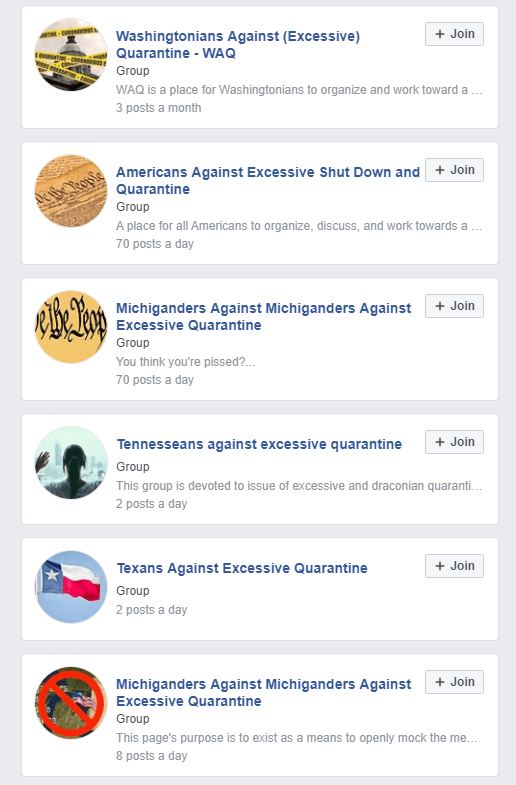
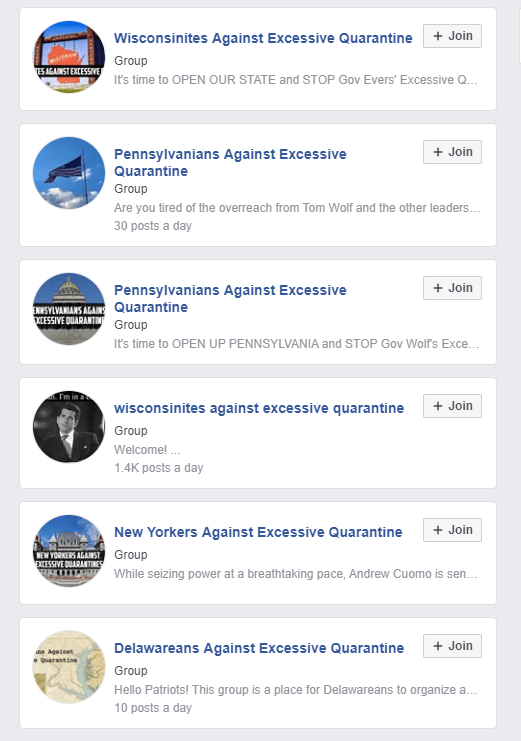
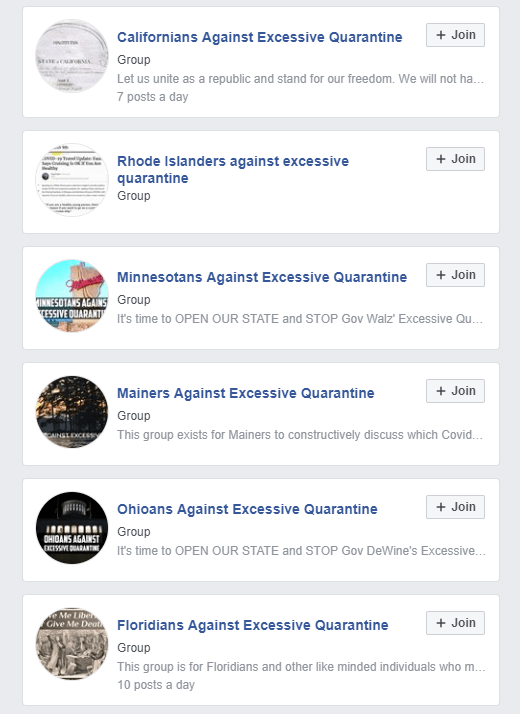
In a stark contrast to worker’s striking for the right to stay home and protect their health, this week many have taken to the street to protest government-mandated quarantine and social distancing. Constituents in states where governors have imposed strict stay-at-home orders have formed Facebook groups ‘against excessive quarantine’ where they discuss the supposed governmental overreach and authoritarian nature, and organize protests.

It seems as if the recent movement is a vocal minority of the country, where Pew Research Center has published polls relating to COVID-19 that show the American people–both Democrats and Republicans–generally approve of their state official’s handling of the crisis, though there is a clear partisan split on Trump’s handling of the crisis. The motivation for these protests supposedly stems from the feeling that citizens’ personal freedom has been stripped, and that “keeping healthy people at home” infringes on basic American rights.

Given the severity of the crisis, these protests are unlikely to push governors to ease restrictions at the moment, though they may pressure officials to work towards a relatively soon and swift ‘reopening’.

In France, it seems that protests have disappeared from the political landscape for the time being, save for worker strikes against Amazon and other companies to demand the right to stay home and protect themselves. Despite significantly stricter restrictions and controls nationwide compared to the patchwork of local and state orders in the U.S., the French don’t seem to feel as if their liberty has been unduly sacrificed for the security of the country.

American protests seem to be less common and significant than in France, and contradictions and counter-protests often inhibit movements from bringing about fundamental changes in company and government policies. Although I generally admire the French’s inclination to fight for what they believe in, at this difficult time it is not the time to mount protests and flaunt government restrictions, which the nation of France seems to understand, despite their love for protests.

COVID-19 and Systemic Issues in the U.S.

Due to the spread of COVID-19, much of the U.S. has put social distancing measures into effect, closing schools and businesses, and advising against social gatherings or domestic travel of any kind. Unfortunately, the pandemic has placed huge stress on an already strained country, showcasing the flaws in many vital systems.

Essential to the survival of many in this pandemic is a strong healthcare system, something the United States unfortunately does not have. Even as the number of cases climbs in the U.S. , the short supply of tests and the high price of treatment for uninsured Americans leads to fears of underestimation. Many governors have expressed how a lack of testing leaves them completely unaware of the true scope of the emergency in their states. Horror stories about patients not receiving treatment and dying due to a lack of insurance (or the right insurance) or medical racism flood social media.

On top of the obvious health crisis is the looming economic ramifications of shutting down a country for the length of time necessary to mitigate the pandemic. As the new month starts and many have been out of work for up to two or three weeks, many Americans stress over their (in)ability to pay rent, utilities, and other bills. Among these expenses is the price of a quality broadband connection, which this crisis has made essential for learning, working, and communicating with the world.

A number of actions have been taken both by the government and private corporations in an effort to ease the strain on the American people. Internet and phone providers have enacted various policies waiving fees, removing data caps, and providing free wifi or hotspots in some regions. Some major insurance companies have announced plans to protect patients from the high costs associated with COVID-19 treatment. Such pledges sound great, but for the 151 million Americans who receive insurance through their employer, this promise does not immediately apply. For these Americans, their healthcare depends on decisions made by their employer and whether or not their policy is with the specific companies who have come forward. As businesses close their doors and lay off employees, many of those 151 million Americans may find themselves both out of work and without insurance at such a critical time.

In addition to the rush to ensure American citizens can access and afford healthcare, the government is scrambling to prevent an immense economic depression. A record high of over 3 million unemployment applications have been filed in one week, as a relief bill was passed to add $600/week to unemployment benefits, and send a one-time check of $1200 to independent taxpayers with incomes less than $75,000. Any financial help is surely appreciated, but many fear it won’t be enough to survive a prolonged shutdown, and are pointing to systemic failures and wealth inequality leaving the country ill prepared for a pandemic scientists have been warning of for years.

The broken healthcare system and economic crisis facing the American people arises from a ‘bootstrap’ culture, a sort of perversion of the American Dream. At the foundation of American culture is this value of self-made success and social mobility, the idea that anyone can become wealthy if they work hard enough. The emphasis on the idea that anyone can do well and thrive in America if they just work hard ignores a lot of systemic forces that hold back people of color, women, and queer people. Such a mindset also ignores the advantage that being born into a wealthy family affords. A common phrase is to ‘pull yourself up by the bootstraps’, making ‘bootstrap culture’ a fitting name for the way many Americans perceive social mobility and wealth inequality–the responsibility is wholly on the individual, not the system.

This ‘bootstrap culture’ pushes people to lean away from a more socialized democracy, such as the models in France and other European countries, which has directly influenced the current crisis. With the upcoming election, many hope that the country will move towards fundamental change now that such issues have been put on display, but we will see.

Transportation and Fare Evasion in France

One of the things I most appreciated in Grenoble was the ease of travel. I was lucky enough to live in the hyper-centre and could walk to most places, or take the tram just a couple of stops. My host parents rode bikes or walked, which seemed typical for a Grenoble resident.

Compared to the Green Line running through BU campus, the tram in Grenoble was a dream. Although it could get packed, there was usually a decent amount of space, it was easy to take, smooth, and clean.

We were given monthly tram passes as part of our program, something that made taking the tram really easy and convenient, especially where you just tap your card and walk onto the train.

At the beginning of the semester, Céline warned us about the contrôle, and how we may be fined if we forget to tap our cards and the month has lapsed. Seeing as how we had automatic monthly passes, I didn’t think much of it and just tapped my card every time I rode the tram.

Well, I found out the price of fare evasion when my girlfriend visited and we rushed to get on a train without buying her a ticket first: 61 euros, and yes, the contrôle takes card.

Fare evasion has recently been debated in public discussion in the U.S., when New York City began implementing measures to try to stop fare evasion, which has increased as the city’s subway system deteriorates. If the police catch you evading the fare, you could be fined $100, receive a civil summons, or be arrested.

In Boston, MBTA policy dictates that the initial fine for fare evasion is $100, and then it increases every subsequent infraction, though I have seen many people get on the train without paying where it runs above ground through campus, and never seen anyone get stopped for fare evasion.

Overall, I think the public transportation system in Grenoble functioned much better than most American systems, which also helps towards preventing fare evasion, where passengers are more likely to pay for a ticket when the service is good.

Not only was the tram clean and reliable, but I found that it was much more accessible than most systems in the U.S. The tram system is entirely above-ground, with gently-sloped ramps up to the platform, and a smooth transition from the platform to the train. Additionally, there are clearly marked seating sections for elderly and disabled people, and some trains had seats the fold up to leave room for wheelchair users. Many subway systems in the U.S. are inaccessible due to the underground platforms and a lack of working elevators, and stairs at the entrance to many train cars.

Additionally, the contrôle system seems much more effective than in American systems. Though the checks were random, meaning there’s a chance you won’t be stopped, they are efficient and effective, and there seemed to be a general trust and honor system where riders usually paid, making it a non-issue. Because the tram system operates so well, passengers see no issue with paying to support it, where in the U.S. the dysfunction of public transportation leaves passengers disgruntled with being charged what is sometimes a relatively high fare for unreliable service.

Just like with the higher education, France’s investment in providing citizen’s with a good service, and the individual’s responsibility to the group by paying the fare, work together to create and maintain a pretty well balanced transportation system.

From Laid-Back France to Unending ‘Coronacation’: A New England Need for Structure

As we adapted to life in France, many of us noted how much more time we seemed to have, how the lack of homework and intensity in classes sometimes made us feel like we weren’t even taking classes. Compared to academic life at BU, UGA was a breath of fresh air, though sometimes surreal. Then, just as we finished a grueling week of midterms that brought us back towards the reality of classes, we got sent home.

At least for me, I have even less structure at home than in the low-pressure environment in France. The transition to online classes has led some of my courses to strictly assign individual reading and problems, with professors available to answer questions, but not having live lectures at all. Others still have live lectures but had to change the structure of the course in a way that leaves a lot of work to be done on students’ own time.

On campus in Boston, I appreciated a rigorous structure and routine. Classes at a set time, regular deadlines for homework, and scheduled times for band and taekwondo. Every week I wrote a list of my assignments and stuck it to my laptop, filled out my planner, and had a clear idea of how I would structure my week. Truthfully, I thrived on the constant academic stress, which was just enough to keep me motivated and focused, while still having clear times for hobbies and hanging out with friends.

Now that I’ve come home, I’ve quickly fallen behind in my courses, and struggle to focus in my house–a house that my family moved into at the beginning of the semester, which isn’t really ‘home’ to me and might not ever be. When we heard we were coming home I naively thought that I might be able to go to the library or a local coffee shop to do schoolwork. Instead, I am essentially in one room all day everyday trying to motivate myself to read textbooks, review notes, and tackle problem sets.

The unclear timeline of this ‘Coronacation’ as many jokingly called it at the start, only adds to the stress. Summer plans for jobs and internships or research are up in the air, leaving students with both financial and professional uncertainties, as well as more time at home with our families than we’ve spent since high school. As the situation worsens in the U.S., concerns about whether BU will reopen for the fall semester grow, which would extend this sort of limbo another four months.

Personally, I need some sort of structure and pressure, with outside responsibilities to keep me busy. I can make as many schedules and lists as I want at home, but without physically going somewhere, nothing seems real enough to motivate. Of course, some of this is just the way I function, but it’s also part of the academic culture at BU and the overall New England culture.

At BU, almost everyone is stressed and busy almost all the time, with classwork, extracurriculars, and trying to be a healthy living person with a social life and sleep schedule. Everyone is expected to work hard and give all of their effort to school while they’re on campus.

Much of New England operates in a very similar way–or at least that’s the way it’s stereotyped. As someone who’s lived here my entire life, the stereotypical New Englander is someone with a full schedule, fast-walking down the street with an iced coffee in one hand (Dunks’ of course) and a laptop bag in the other. New Englanders are always on the go and always working in one form or another.

The stereotypical New Englander as drawn by Sarah Borce of CT

New England culture is greatly attributed to the Puritans, who largely settled the area in the 1600’s, and believed in strong local communities that followed the Bible, and valued a strong work ethic.

Puritans working in the New England colonies

This borderline-workaholic New England culture greatly contrasted with the French outlook, and it is hard to get back into that work ethic. Part of the Puritan philosophy was that idle hands are the “devil’s workshop”. While the religious aspect is not very applicable to me, I have always found my work ethic a little like treading water–if I stop moving I start sinking. In the three weeks that I have been home, this is certainly true, as I have started to drown in coursework and home responsibility.

Hopefully, the pandemic ends reasonably soon and everyone can return to their packed schedules in the fall–it will only get harder to get back to the surface the longer we stay at home.

Why Americans Are Starting So Many Projects–And Haven’t Before Now

As people around the world isolate themselves to slow the spread of COVID-19, many find themselves with an unexpected abundance of time, and are starting projects or learning new skills to fill the days.

Bread baking, gardening, painting, embroidery, and mask-sewing are just some of the projects isolated people have begun to take up in their spare time.

My family has not been immune to the project-starting craze. The biggest ‘project’ is moving out of our old house and fixing it up, but there are plenty of other things on our list.

In addition, we’ve made plans to build out our garden with raised beds and a greenhouse, to build a desk, and to replace the carpet upstairs with vinyl flooring. We’ve also been cooking and baking a lot more than usual.

In France, I was pleasantly surprised by how much time my host parents had to pursue hobbies such as music and cooking, while still spending lots of time with friends and family. It seems to me that in America (or at least New England) we’re often so busy and stretched so thin that we don’t have the time or energy for hobbies. At school, any free time I have is spent trying to relax and shut my brain off, usually hanging out with friends or watching Netflix. There are plenty of things I’d like to learn, like baking and embroidery and woodworking, but I never seem to have the room for it.

One of the biggest factors that contribute to this contrast is the economic systems in each country. In America, one expects to have a 40+ hour work week, often taking work home, and very little vacation time. All the time spent at work, along with commuting, cooking, cleaning, and taking care of the people in your household leaves very little time for Americans to devote to hobbies and projects outside of their professional life. A 2019 survey claimed that Americans had less than half an hour of free time a week, and often are so busy they neglect household tasks like cleaning and maintenance.

On the other hand, the French work week is 35 hours, with a minimum of 30 days paid vacation plus 11 national holidays. In spending less time at work, the French have on average 15 hours of personal time each day. This number does include sleep, cooking, and cleaning, but if we estimate a maximum 12-13 hours spent asleep and taking care of the house, that’s still 2-3 hours a day to relax and explore hobbies.

The lack of relaxation time in America during an average week makes the isolation period seem like an unsettling amount of free time. Some may dislike the gross amount of time spent at home, but I can’t imagine that working Americans wouldn’t appreciate a little more time every week to relax and pursue fulfilling hobbies other than watching Netflix. In France, strikes and unions are quite common, and the workers have quite a bit of power, which is a big part of why the work week is less heavy. As the pandemic changes the economic landscape of America, people are realizing how little protection and power the average worker has, and have begun striking at companies like Amazon and Instacart. Hopefully, we will see a transformation in the economic structure to allow Americans more personal time and protection after this pandemic, but fundamental change may be hard to bring about.

No one knows what will happen when the restrictions are lifted and the country begins to return to normal activity, so for now all we can do is enjoy our fresh-baked bread and find something to fill our time.

France vs The U.S. on Flattening the Curve

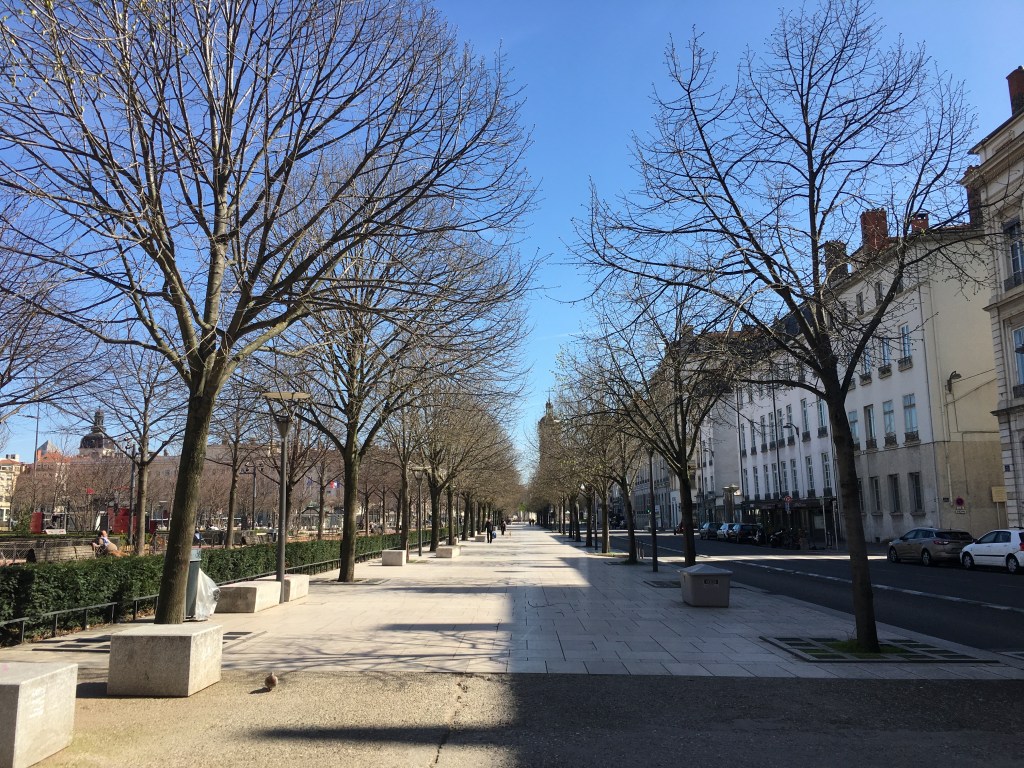
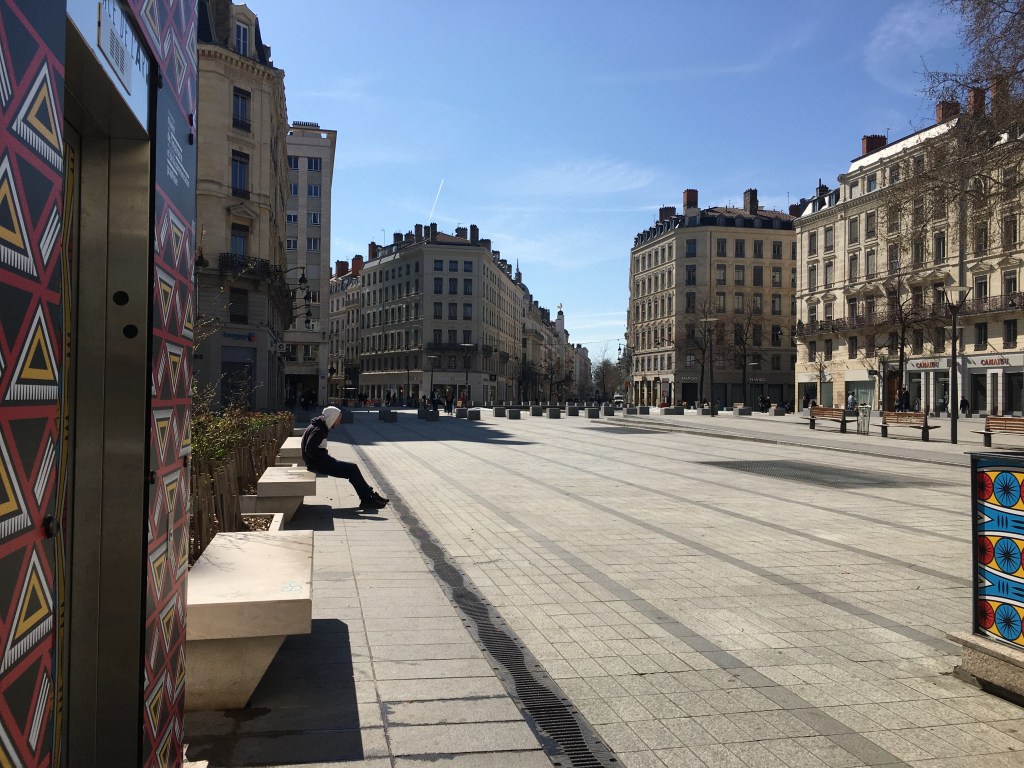
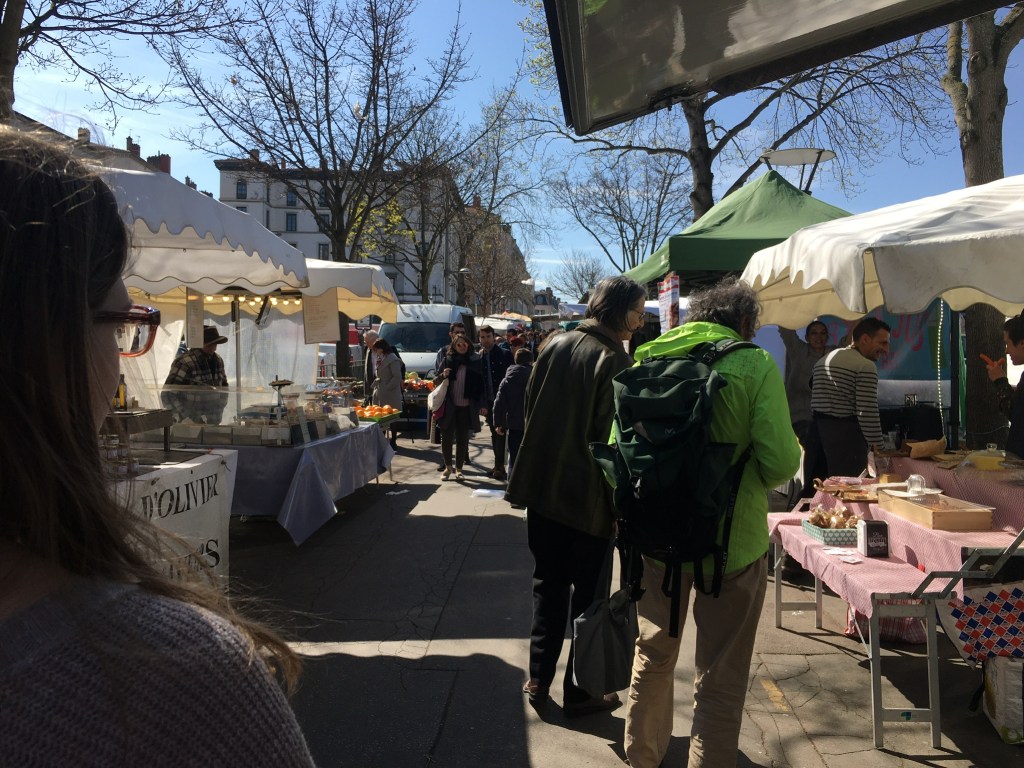
My last full day in France was spent in a nearly abandoned Lyon. My girlfriend and I went to Marché St Antoine where vendors wore masks and passed food and money back and forth in gloved hands–an irony not lost on us as we ate our bread by the river. On midnight the night before, the French government had enacted an order closing all nonessential businesses, allowing only a select few to remain open, which luckily for us included the open air market. While there were no doubt significantly less people out than a normal day in Lyon, we still saw families and groups of teens at the local park, and a pretty busy subway and supermarket.

The next day we flew home to Boston, first stopping in London Gatwick for a nearly eight hour layover. Leaving France, we saw huge lines at the check-in for Lufthansa, but had no problem checking in with easyjet and going through security. In London, we were only screened when re-checking my bags with Norwegian. An employee asked us a few questions about what we were bringing with us and if we had knowingly been in contact with anyone confirmed positive for COVID-19. We were again screened when entering the waiting area at our gate, and given a form to fill out for U.S. customs. Not long into our wait, we learned that France had gone into a strict lockdown, limiting citizens’ movements in an attempt to slow the spread of COVID-19.

Our flight to Boston was only half-full, a frustrating fact considering I had to pay for a more expensive ticket four days earlier, when the flight was full. After landing, we were expecting a long wait in customs, but it took only an hour to go through screening and pick up our bags. Apart from the screening at airports, no widespread measures had been put in place to slow the spread of COVID-19 as they had been in France.

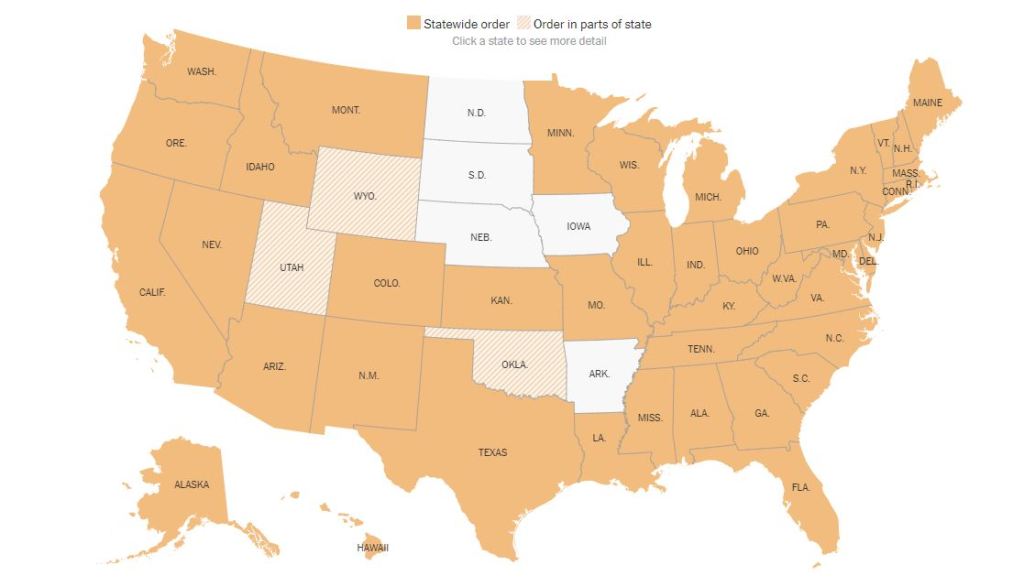
Almost a month later, the United States still hasn’t implemented a country-wide shut down. Many states and local governments have restricted the movement of citizens and closed schools, cancelled events, and ordered all non-essential businesses to close. Some areas have implemented curfews to force people to stay home. My state is stopping every out-of-state license plate and ordering them to quarantine for 14 days unless they are commuting for work at an essential business.

By The New York Times, as of April 14th, 2020

The White House holds a briefing every day, as do many state governors, and there has been conflicting messages from local and federal government. One thing everyone seems to agree on is social distancing. Two weeks ago every postal customer in the U.S. received a card advising everyone to practice social distancing in order to slow the spread of the disease.

Now, both France and the U.S. are looking to slowly reopen their economies around mid-May, though it may be a little early for the U.S. Projections show that the pandemic is currently in the middle of the peak in the U.S., while France is thought to have peaked in resource use nearly two weeks ago, and in deaths over a week ago. While the gross total of cases in each country indicates that the U.S. outbreak is more severe, the per-capita data indicates that this may not technically be true. According to the site Our World in Data, the U.S. has a total of 70 deaths per one million citizens, where France has 230 deaths per one million citizens. This contrast in per-capita data may be because of the difference in timeline, where France is a little ahead of the U.S. on the curve. But even more significant is the clustered nature of the outbreak in the U.S., where the country is hard hit in areas like New England, New Orleans, and the Northwest, but the virus is not yet widespread over the entirety of the country. We saw such clusters while we were in France, but not quite with the severity that hotspots like New York City have experienced.

It’s hard to say whether one country is doing ‘better’ than any other in mitigating this crisis, but the one thing that is obvious is the actions taken by each government and the citizens’ obedience to such orders.

France has issued much stricter, more global measures to mitigate the virus, and has a generally more coordinated approach through Macron than the United States has shown. Confusion on the duration of the shutdown and how people will be cared for has created frustration for some Americans, and doubt of the virus’ severity in others. Governors in various areas of the country have begun to coordinate their response, something the President has discouraged and lashed out against, wanting ultimate control over the country, but unwilling to put in place the stringent measures that are necessary to slow the virus. President Trump has insisted that “[governors] can’t do anything without the approval of the President of the United States” , yet repeatedly issued contradicting statements about the severity of the virus and how to approach it.

Only time will tell how each country’s handling of the crisis will impact the overall tolls, but hopefully the efforts of individuals to adhere to social distancing will be enough to flatten the curve and minimize the tragedy.

France

Attending A French University

Before coming to France, I had been told many things about the educational aspect of the program: there’s no homework, you won’t know what your grades are, everything is based off exams, there’s two vacations…

But nothing really gave me an accurate expectation for UGA or the educational system we entered. The first shock that came to me was that most universities in France are public, and cost almost nothing for the students.

When we started taking classes at UGA, the DLST building reminded me of my high school experience. All of our classes were in one building, and they were much smaller than the lectures we take at BU. The classrooms themselves were also set up much more like a high school classroom than a college lecture hall. Most students didn’t live on campus, and would fully dress up for classes. I would often see girls wearing skirts and tights or a coordinated outfit, which was common in my high school but not as common at BU where you live a five minute walk from classes and often just throw on jeans and a shirt and head to class in the morning.

The difference in higher education shows a cultural contrast between Americans and the French. It seemed to me that the French generally cared more about the access to higher education than the average American does. For me, the biggest contrast was the price of education, where students may pay only a few hundred euros per year, and the cost in America is at least $1000 at public colleges, but up to $80,000. To me, this shows that the French find investing in the education of young people worthwhile. It also exemplifies one of the core French values (liberté, égalité, fraternité), where the low cost of higher education makes it available to almost everyone, regardless of background.

We were also told that since tuition was so low (and the grading system was different), French students tended to be less stressed about school and not care as much about getting the highest score. I found this to be true in some aspects, but not overall. The students we shared a physics class with definitely seemed less worried about courses than we did, but they still took school seriously.

Students at the university sometimes seemed a little more immature than American college students, which attributed to the high school feel of UGA. Over the semester, we learned that many of the responsibilities and privileges we acquire in our mid-teens in the U.S. like a formal job and a driver’s license, are not common for French teenagers and university students. Additionally, students seemed to approach the school day as more of a social activity, where we would see people grouped together in the halls, lined up at the vending machines, and whispering throughout class. While students at BU may do this, the overall vibe is more academically focused, and people are often so physically spread out that it seems less obviously social.

The way students dressed played a large role in the social feel of campus. Although we discussed the French dressing in a conformist way because of a community mindset, this didn’t seem to totally apply to young people. It was clear that the French students had put thought into their outfits each day, and classes seemed to be more of an event to get dressed for as one would for the school day in high school, rather than just class as we might think of it at BU.

When one of the French kids asked me what I thought of UGA I answered him honestly, that it reminded me of American high school, which he seemed a little offended by. But honestly, it’s not a bad thing. France and French culture has made college a low(er)-pressure environment where most students can go at their own pace, socialize, and still have time for themselves without worrying about getting all A’s or how they will pay for school. Coming from a higher pressure environment, UGA seemed a little weird at first, but I appreciate the freedom the French education system offers its students. The investment France has made by providing low-cost education to all truly reflects on their values of community, and the importance of égalité.

Micromégas: My time in a French band

Before coming to France, I had emailed Céline about the possibility of playing music in Grenoble, as I could bring my clarinet but it didn’t seem as if the University had a music program. Luckily, I got placed with a musical family. My host mom plays the accordion and practices every night in addition to taking a class and participating in a few different musical groups. After I arrived and told them about my instruments and that I had brought my clarinet, she promptly invited me to join the Micromégas, a community jazz band she played in.

I was able to attend four official répètes of micromégas, and two informal practices held at my host family’s apartment. In this time I was able to be involved in a small community and play jazz music for the first time in years.

Although I didn’t necessarily form any close friends with anyone in micromégas, I found everyone to be quite welcoming. My first répète was without my host mom, and I wasn’t able to introduce myself to the director before rehearsal started, but he didn’t even question my presence there. I sat down with the clarinets, and we played through the music.

The band was made up of maybe 30 amateur musicians aged 11 to 82. Although we didn’t rehearse all together often, it was clear that everyone practiced on their own and worked hard and really loved playing with the band. I was surprised to see younger musicians, as community ensembles in America are mainly people who have graduated college, where most students play in ensembles at school from middle school through college.

Another surprise to me was that everyone knew solfège, which is used with fixed do in Europe. Solfège is a series of syllables (do,re,mi,fa,sol,la,ti,do) assigned to each of the notes in a scale. In most of the world, musicians used fixed do, where each syllable always corresponds to a note in the C major scale. In the U.S. and Canada, movable do is used, where do is simply the first note in any scale, and you continue the scale with the other syllables. Solfège also has other syllables for accidentals, and hand signs that accompany each syllable.

Often the director would instruct us or give a new line in solfège, and everyone would just go right into it. At one point I asked the girl next to me (an 11 year old clarinetist who is amazing) what the notes were, and I ended up having to ask quite a few people in order to get the actual notes instead of just the solfège. In my high school music program, solfège with movable do was only used in chorus, where hearing the pitch intervals was more important than translating the syllable into the note on the page. In chorus, solfège was manageable, but in band I am not able to hear a pitch and figure out the note, or translate the solfège into it’s letter components, and was utterly lost.

The knowledge of theory and the work all the musicians put into practicing for Micromégas showed an immense amount of discipline and dedication. Everyone in the band took it very seriously, and had a great deal of fun making music. Often other band members or my host parents would casually ask me “travaillait-tu les morceaux?” a casual question that would be more of a call-out in American ensembles. I have never been great about practicing, unless I knew something was very difficult, and I was a little taken aback by everyone just casually asking each other if they’ve practiced. But I came to realize that it was about group accountability, something that’s really important in an ensemble. Everyone needs to be putting in effort and know their part before coming to rehearsal in order to work on balance and blend when everyone is together. My host mom practiced every night, but would also schedule social practices in weeks where we didn’t have formal rehearsal. A couple of her friends in the same instrument group (accordion and upper woodwinds had surprisingly similar parts) would come to the house and we would work through the parts together before all sitting down to a late dinner.

It was a great experience to be able to be a part of this small community of musicians and play some fun jazz music while I was in France, and it taught me a great deal about French culture and music. The dedication and group accountability of the musicians reinforced the concept of French communautarism, and how the good of the group eventually returns to the good of the individual. As we continue our isolation, I’m not sure when I’ll be able to play in a musical ensemble again, and I am really grateful to have participated in Micromègas while in France.

The Importance of Family in France

La Famille: une mère, un père, des enfants, et peut-être les grand-parents. My first week in France, my host parents asked me quite a bit about my family–and told me about theirs.

My host parents have three adult children, two daughters who live elsewhere in France, and a son in Grenoble. On my first night, my host father told me they were expecting their first grandchild, who was born the week our program was cancelled, and the entire family gathered to celebrate that Saturday, just as I was packing my bags to leave Grenoble.

Every Saturday my host parents had lunch with my host mom’s mother who lived on the same floor, and every Sunday we all sat down to dinner, sometimes with their son and his girlfriend joining us.

When I told them my parents were divorced, they said that was a pity, and I got the sense that they really valued having a healthy family and home. In my experience in America, people generally aren’t surprised or upset by the news that someone’s parents are divorced. The difference in reaction didn’t surprise me at first, even though France and America both have divorce rates around 45%. After some further research, it appears that a lower percentage of the French population get married each year to begin with–there are about 3.4 marriages per 1,000 people each year in France, versus 6.5 marriages per 1,000 people in America. So, while approximately the same percentage of married couples may divorce each year, there is a higher percentage of the total population that has been married and divorced in America, making it seem more common. It is also seen frequently in TV dramas and movies, contributing to the availability bias Americans may have towards acknowledging divorce.

It seemed to me that French people approached all relationships more cautiously and intentionally than Americans, something we discussed with Professor Rostas at the beginning of the semester. In France, it would take a bit of effort to become someone’s friend and get to know them, but once you become friends you are very close. Comparatively, in America we often might have people we consider friends simply because we see them every day in class, or live on the same floor. Not a lot of effort goes into developing these sort of tangential friendships, and there isn’t a strong bond–once the class ends or you move to a different building, maybe you never see that person again. This isn’t to say that Americans don’t have close friendships, but rather they’re more likely to call someone a friend that the French might think of as just an acquaintance.

Just as close friendships are important to the French, marriage and family hold equal, if not more, weight. Something that clearly shows the importance of family is the Livret de Famille, a book containing information about the marriage, birth of children, and other important events for a family. A couple normally receives their Livret when they become married or when their first child is born. From then on, the Livret serves as an official record for the family, and as a form of identification in official situations. The fact that a record of the entire family is considered identification for each of the members sends a strong message: the family is just as important as the self, and should be taken care of with the same respect. That being said, individuals aren’t expected to give up their personal identity and totally devote themselves to the family. Rather, everyone is able to be unified and individual at the same time, enjoying their differences as much as what they share.

Personally, I think family is very important, but shouldn’t be something to strive for just to have a family. Many people get married for the wrong reasons or without thinking it completely through, and I think the weight of a Livret really emphasizes that starting a family is not something to take lightly. As to whether or not French families are healthier or happier than Americans is something I don’t know, but family is definitely important in French culture.

Design a site like this with WordPress.com
Get started