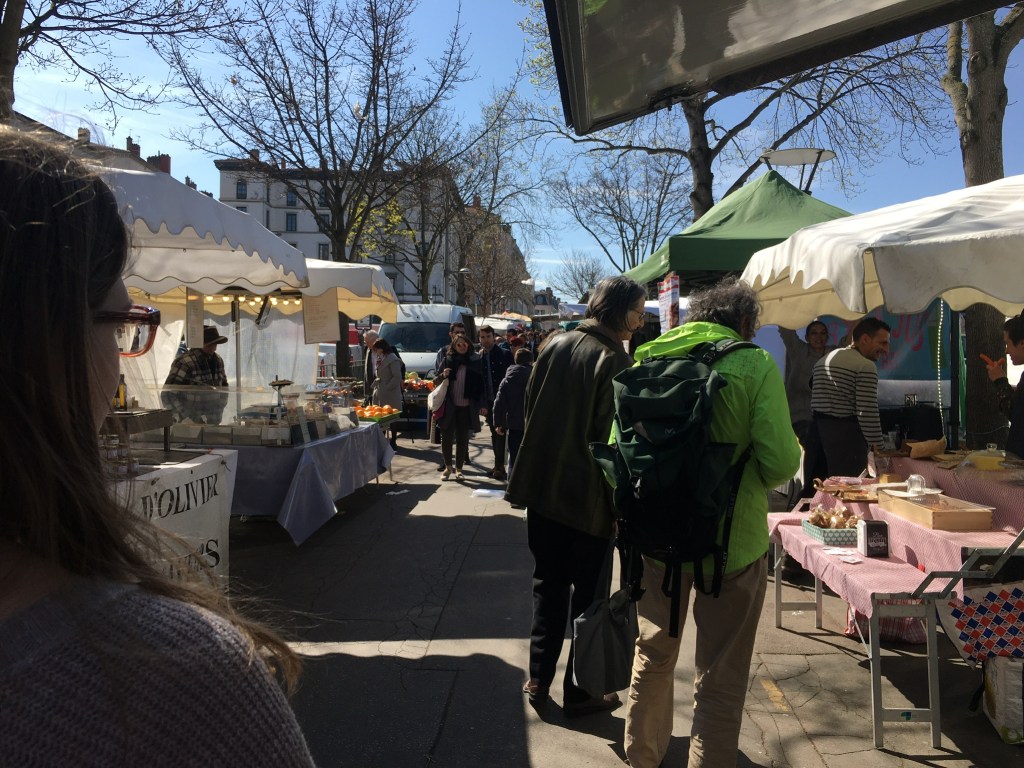
My last full day in France was spent in a nearly abandoned Lyon. My girlfriend and I went to Marché St Antoine where vendors wore masks and passed food and money back and forth in gloved hands–an irony not lost on us as we ate our bread by the river. On midnight the night before, the French government had enacted an order closing all nonessential businesses, allowing only a select few to remain open, which luckily for us included the open air market. While there were no doubt significantly less people out than a normal day in Lyon, we still saw families and groups of teens at the local park, and a pretty busy subway and supermarket.


The next day we flew home to Boston, first stopping in London Gatwick for a nearly eight hour layover. Leaving France, we saw huge lines at the check-in for Lufthansa, but had no problem checking in with easyjet and going through security. In London, we were only screened when re-checking my bags with Norwegian. An employee asked us a few questions about what we were bringing with us and if we had knowingly been in contact with anyone confirmed positive for COVID-19. We were again screened when entering the waiting area at our gate, and given a form to fill out for U.S. customs. Not long into our wait, we learned that France had gone into a strict lockdown, limiting citizens’ movements in an attempt to slow the spread of COVID-19.
Our flight to Boston was only half-full, a frustrating fact considering I had to pay for a more expensive ticket four days earlier, when the flight was full. After landing, we were expecting a long wait in customs, but it took only an hour to go through screening and pick up our bags. Apart from the screening at airports, no widespread measures had been put in place to slow the spread of COVID-19 as they had been in France.
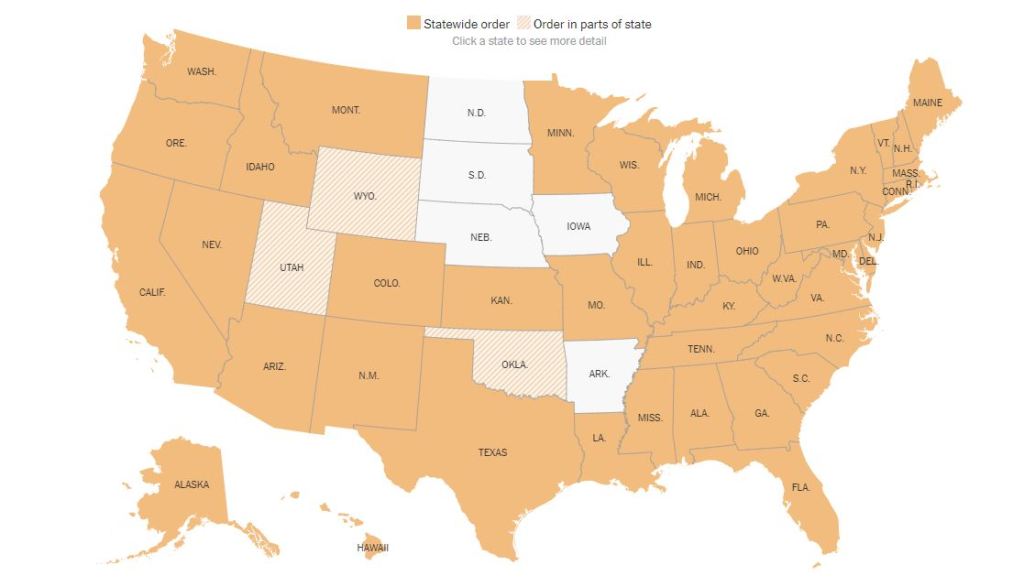
Almost a month later, the United States still hasn’t implemented a country-wide shut down. Many states and local governments have restricted the movement of citizens and closed schools, cancelled events, and ordered all non-essential businesses to close. Some areas have implemented curfews to force people to stay home. My state is stopping every out-of-state license plate and ordering them to quarantine for 14 days unless they are commuting for work at an essential business.
The White House holds a briefing every day, as do many state governors, and there has been conflicting messages from local and federal government. One thing everyone seems to agree on is social distancing. Two weeks ago every postal customer in the U.S. received a card advising everyone to practice social distancing in order to slow the spread of the disease.
Now, both France and the U.S. are looking to slowly reopen their economies around mid-May, though it may be a little early for the U.S. Projections show that the pandemic is currently in the middle of the peak in the U.S., while France is thought to have peaked in resource use nearly two weeks ago, and in deaths over a week ago. While the gross total of cases in each country indicates that the U.S. outbreak is more severe, the per-capita data indicates that this may not technically be true. According to the site Our World in Data, the U.S. has a total of 70 deaths per one million citizens, where France has 230 deaths per one million citizens. This contrast in per-capita data may be because of the difference in timeline, where France is a little ahead of the U.S. on the curve. But even more significant is the clustered nature of the outbreak in the U.S., where the country is hard hit in areas like New England, New Orleans, and the Northwest, but the virus is not yet widespread over the entirety of the country. We saw such clusters while we were in France, but not quite with the severity that hotspots like New York City have experienced.
It’s hard to say whether one country is doing ‘better’ than any other in mitigating this crisis, but the one thing that is obvious is the actions taken by each government and the citizens’ obedience to such orders.
France has issued much stricter, more global measures to mitigate the virus, and has a generally more coordinated approach through Macron than the United States has shown. Confusion on the duration of the shutdown and how people will be cared for has created frustration for some Americans, and doubt of the virus’ severity in others. Governors in various areas of the country have begun to coordinate their response, something the President has discouraged and lashed out against, wanting ultimate control over the country, but unwilling to put in place the stringent measures that are necessary to slow the virus. President Trump has insisted that “[governors] can’t do anything without the approval of the President of the United States” , yet repeatedly issued contradicting statements about the severity of the virus and how to approach it.
Only time will tell how each country’s handling of the crisis will impact the overall tolls, but hopefully the efforts of individuals to adhere to social distancing will be enough to flatten the curve and minimize the tragedy.
France
 Julianna Hill