When I was researching Grenoble to give a reason on my Study Abroad application other than “I just want to go to France” I found out that there is a lot of green energy and sustainability initiatives in and around the city. As someone who wants to go into clean tech,I found this pretty cool. Shortly after arriving in Grenoble, Céline pointed out to us how the building housing the BUSA office is labeled ‘Bonne Energie’. One of the first buildings of its kind, the office uses solar panels and a geothermal well in the basement to produce all of the energy needed for daily operations, and then some, making it energy positive.
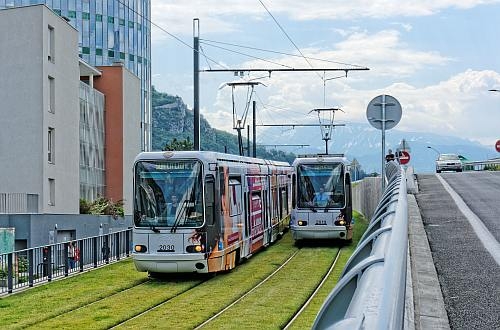
Even in January, in my first days in Grenoble it struck me how the city was literally green. Though there were definitely areas with purely city buildings and cement, small pockets of grass and foliage peeked out throughout the city, even on the tracks of the E line.
In our first few discussions with Christine and Céline, they impressed on us how the French feel a much more personal responsibility to sustainability than Americans do, emphasizing recycling, composting, and taking short showers.
I certainly observed these behaviors throughout the city and in my host family. Often I would see recycling and compost bins alongside regular trash cans, where in America there would only be a regular trash can, and maybe a recycling (in shopping centers, on the street). There was also a distinctive lack of litter throughout the city, I seldom saw trash cans overflowing or litter on the street, except for maybe very late at night. The lack of litter was not something I consciously noticed right away, maybe because Boston is a considerably clean city in this regard. However, when Blaire and I traveled to Italy for our winter break, I was appalled at the litter in most of the cities we traveled to, which definitely strengthened my appreciation for Grenoble’s environmental attitude.
At home, my host parents almost never used single-use plastic. The two trash cans in the kitchen were for compost, and then everything else, which was usually mostly recyclables or paper bags. Even their food choices seemed more sustainable than the average American family. In addition to buying from local shops, bringing your own bag, and not wasting food, the actual dishes themselves seemed greener. My host parents invited me to eat with them whenever we were home at the same time, and most nights dinner was fish or chicken, along with bread and some sort of vegetable or rice. Of course, these meals don’t seem very special, but what struck me was how seldom they ate red meat, the production of which is often pointed to as a hefty contributor to pollution.
Overall, I got the impression that the French cared greatly about the environment, and felt a personal level of responsibility to preserve our planet. In America, many people care passionately for the environment, myself included. However, the contributions of large corporations polluting on a mass-scale have often been cited in debates about responsibility. I first remember this when a video of a turtle with a straw up its nose was circulating, and started a push to limit the consumption of straws and other single use plastics. These goods are important for many disabled people to be able to drink when they may not be able to lift a cup, or maintain a living space when the ability to wash dishes is limited, among a myriad of other reasons. To demonstrate the relative harmlessness of individuals using necessary single-use aides, people began looking to large corporations who dump tons of plastic in the ocean every year. This turned into a majority of people pushing aside personal responsibility to the environment to point at the corporations.
In France, I didn’t see the corporation-blaming sentiment, and no one seemed put-out to do their part in caring for the environment. This probably stems from a combination of a community based mindset and an aversion to waste passed down from recent wars.
In our lessons, we learned about how the French were more community minded than individualistic, and generally felt a personal responsibility to the good of the whole whether that be the town, country, or planet. I saw this community concern in many forms throughout my time in France, and I truly admire the way the French care about their role in the bigger picture, especially when it comes to preserving our planet.
 Julianna Hill